

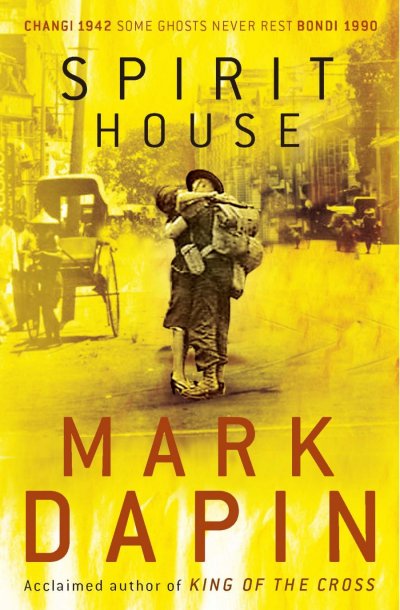
I’m quite excited about this week’s Fibro Q&A. Usually when I am talking to Mark Dapin, we discuss roundabouts, penguins, social media, beer, driving, children, our mutual friends, the state of the world and the state of our various projects (his more exciting than mine).
It is a rare event for me to actually drill him about writing. I’m not sure why. Maybe I’m shy (and I can hear him laughing from here…). Maybe I don’t want him to know how much I truly don’t know.
Probably it’s just that the conversations about roundabouts are far too scintillating to warrant a change of subject. Something like that.
Anyway, he writes a popular column for Good Weekend, first-rate features, (probably) best-selling non-fiction books, award-winning novels… possibly even poetry (but no doubt that’s hidden in a drawer).
His debut novel The King of the Cross won the Ned Kelly Award for Best First Fiction and his new novel, Spirit House, is now in bookshops. So, despite the fact that he does not look like a writer*, I took advantage of his extreme shortness** and invited him to the Fibro to view my asterisk collection*** While he was here, I asked him about writing.
Given that you practice so many forms of writing, do you have to take a different approach with each?
Mark Dapin: “Not really. If I’m writing a feature, I try to approach it as if it were a short story. I identify the main characters, give them a narrative arc and – if the storytelling works – use my 3000 words to gradually reveal the mystery at the heart of the story. I try to write an introduction that drags the reader in, and a conclusion that offers a surprise twist, a kind of reward for reading that far. I use the same technique with the chapters in my novels and slightly scaled-down version**** for my column.”
You put a lot of yourself into your columns and feature stories – does having such a strong voice make fiction writing easier or more difficult when you have to write from a character’s perspective?
MD: “I think every character in every novel written by every writer is, in part, an extension of an aspect of the writer’s own character. When a writer pits good against evil, they’re really, on some level, just detailing the conflict within themselves. So no, not really. I can write hundreds of different Mark Dapin characters – black, white, men, women, short, extremely tall…”
Did you suffer from second novel syndrome when writing Spirit House? Or did having a deadline and certain expectations help you get the job done?
MD: “Yeah, it was much harder to write the second novel than the first. I had to do almost a year of research. I would never do this again. I advise strongly against setting a novel in Singapore in 1942 when you were born in England in 1963. Also, I did a lot of work with my publisher on the plot, which kept flying off in odd directions.”
Given that the role of the author seems to involve so much more marketing/promotion these days, and you also write a weekly column plus regular features, when do you fit in your fiction writing? Are there days when you never want to see another word?
MD: “I just prioritise. I make a (mental) list of what I most want to accomplish in the day, and I do that first. Some weeks, it’s journalism every day, some weeks it’s fiction all week. It kind of depends on my deadlines and my mood. It doesn’t mean the other stuff doesn’t get done, just that everything is completed in the right order. And if I get stuck on fiction, I turn to the column. If it get stuck on a column, I write a feature, and so on.”
What would your advice be for anyone starting out in the writing game – any genre – today?
MD: “Learn to write. Don’t use cliches or formulaic constructions. Read good writers and try to figure out how they avoid repeating the words of others. Every time you finish a sentence, think to yourself, “Have I read this somewhere before?” If you’re writing dialogue, ask yourself if real people talk that way, or just characters on TV. Realise that other people are just as complex as you are and a two-dimensional portrayal of anybody – in journalism, or in fiction – is likely to show up the writer as more shallow than their character. Don’t be precious. Almost everything improves with cutting.”
Spirit House is at the top of my To Be Read pile, covered in a thin layer of renovation dust. I cannot wait to read it. I know that, for me as a reader, it will be funny, and unexpected, and thought-provoking. I know that, for me as a writer, it will be motivating and inspiring and, yes, envy-inducing. You can buy it here. You can also follow Mark’s blog, where he writes about roundabouts (oh yes, he does) among other things.
*have a look here if you don’t believe me
**rumour has it that he is just 9cm tall
***My collection will never match his, but the ruse worked.
****This is a genuine Mark Dapin asterisk. Yeah, yeah, 9 centimetres.
0 Comments