Like every other parent in the history of the world (okay, those who think about this kind of stuff), I’ve considered writing a children’s book. I can tell a story, you know. You should hear the one that I used to tell Mr7 about his bear Bronte back when he was two. Bronte went in search of a pink ribbon. She had to drive many, many miles to find one. It had rollercoaster thrills, laughs and even a moral. It was… meh.
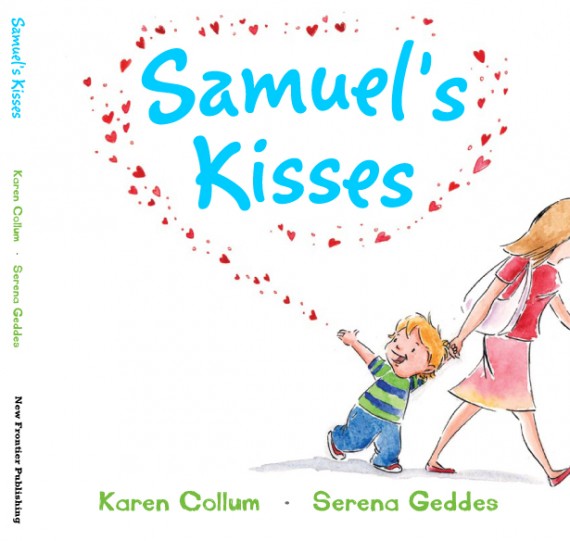
The truth is that ‘knocking out’ a kids’ book is no mean feat. As any writer will tell you, writing short is much, much harder than writing long. Every single word has to work so much harder when they’re limited. Which makes children’s author Karen Collum’s achievements all the more admirable. With two picture books appearing on the shelves almost simultaneously (Fish Don’t Need Snorkels (UK) and Samuel’s Kisses, launched in Australia today, New Frontier Publishing), plus When I Look At You (UK, 2011) and a junior novel, Operation Raspberry, out in 2012, you could say that she’s on a roll.
Given that she also has four children, it’s surprising Karen has time to breathe. But, lucky for us, she found time to pop into the Fibro to answer a few questions for aspiring children’s book authors.
Do you find that people think ‘children’s books are short, they must be easy’? How far from the truth is this?
Karen Collum: “Many people do assume that picture books are the easiest things in the world to write due to their brevity. In reality, I believe picture books are the pinnacle of skill, talent and creativity (then again, I’m probably biased!).
“For me, every single word in a picture book has to fight for its place in the manuscript. Does it propel the story? Does it add to the rhythm of the text? How does it sound when read aloud? Anyone can write a 500-word story, but the masters of picture books – such as Wendy Orr, Mem Fox, and Jackie French – manage to use those 500 words to weave a tapestry of story that is simply divine.”
Do you work on one book at a time? How long does it take you?
KC: “I have multiple projects on the go at once, although they’re usually at different stages of development. I have a notebook for recording ideas on the run: phrases, images, characters or story arcs that might be useful. The next step is to write the first draft. Sometimes that feels as easy as being a scribe; other times it’s as difficult as squeezing words from the proverbial stone. I use a template during this phase, which enables me to think about the text in terms of a standard picture book format of 32 pages. I can think about where the page turns and see where the natural breaks in the text fall.
“I then put the manuscript away for as long as possible – sometimes for 12 months or more – and come back to it with fresh eyes and a sharp knife to begin the editing process. This can take anywhere from a few days to a few months as I agonise over every word. I also workshop the manuscript with some trusted critique buddies and listen to their feedback – which I don’t always take on board, though I do always consider.
“The time frame varies, but for me it’s a minimum of a 6-8 month process to get a picture book from the idea stage to the point where it’s ready to submit.”
Do you illustrate your own books? If not, how does the illustration process work?
KC: “I would love to be able to illustrate, but sadly my artistic talents are almost non-existent. As my friend and fellow picture-book author Kathryn Apel says, we non-illustrators have to paint pictures with our words. One of the best things I can do as an author is to allow room for the illustrator. The best picture books are the ones where the text and illustrations join together to create something so much greater than the sum of the individual parts.
“Once a publisher accepts my manuscript, they choose an illustrator they believe is a good match for my text. Most of the time authors don’t have input to this process. It can be hard to let your precious manuscript go, but I firmly believe that the publisher wants nothing more than to see the book become a roaring success. They choose a certain illustrator for good reason.
“My experience with this process has certainly been a positive one. The illustrations for Samuel’s Kisses [by Serena Geddes] are better than I could ever have imagined.”
What do you think it is that makes our most beloved picture books stand the test of generations?
KC: “For me, timeless picture books are those that reflect our inner experiences and emotions. The classic that springs to mind is Where The Wild Things Are [by Maurice Sendak]. I think that it is still such a loved book because every child has felt overwhelming, powerful anger and wished they could be far away from their family.
“A modern picture book that I think will have longevity is The Princess and Her Panther by Wendy Orr and Lauren Stringer. All children are frightened by something and this book explores fear in a safe, poetic and beautiful way.
“I also think that some picture books stand the test of time due to their beautiful language. Some books are just divine to read aloud again and again, like Bear Snores On by Karma Wilson.”
What was your favourite book as a child?
KC: “I read a lot as a child, but funnily enough I don’t have a memory of any one particular picture book. My dad used to read us bedtime stories every night and I have wonderful memories of warmth and togetherness, even though I don’t have a specific title that stands out for me. I did, however, love the Berenstain Bears books and learned to read independently with The Bike Lesson.”
And I ask you the same question – what was your favourite book as a child?

As a child I loved Ping and the Lyle the Crocodile books. As I got older it wasThe Borrowers and the Little House on the Prairie series. As a childcare provider I prefer to read the children anything by Eric Carle.
As a child I loved Ping and the Lyle the Crocodile books. As I got older I loved The Borrowers and the Little House on the Prairie series.